


Page 19 - Port of Baltimore - Issue 2 2024
P. 19
 QHow did you first become interested in pursuing a maritime career?
I didn’t set out to go into the maritime industry. I graduated from The Citadel [military college in South Carolina] with a degree in International Politics and Foreign Affairs. Initially, I was going to follow in the footsteps of
my father, who was a college football coach. He had also been a member
Change
NEW LEADERSHIP
                             of the International Longshoremen’s Association, following in his father’s footsteps, so I’m actually the third generation in the maritime industry. But my first job as a coach was at Maine Maritime Academy. I spent two years coaching football and lacrosse.
Then, because of my military background, I was asked to take a position in the Commander’s office.
I was commissioned as a Lieutenant in the Merchant Marine and served aboard one of their training vessels. I was responsible as a company officer for two companies during that period. That was my first exposure to the maritime industry.
Our first port of call was Gibraltar. We tie up, the gangway goes down, this gentleman comes up and he’s a ship’s agent. I shadowed him while we were there and that was when
it really hit me that I wanted to be in the maritime industry. I decided to do graduate work at Maine Maritime Academy, in Maritime Management.
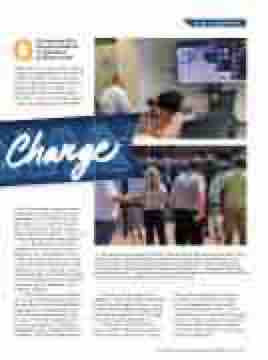
 (Clockwise from top left page ) From left to right: President of Waterman Logistics Henry Nuzum, U.S. Army Lt. Gen. John Sullivan, Maritime Administrator Ann Phillips and new MPA Executive Director Jonathan Daniels. Daniels hosts his weekly stakeholder call to update members of the
Port of Baltimore community on the Key Bridge response. On May 20 — less than two months after
the Key Bridge disaster — Daniels announced to the media the opening of a 400-foot-wide and 50-foot- deep channel that marked another key step in the Port’s recovery.
   As I was moving through that program, I was hired as the Port Director at the Port of Eastport, Maine. I have a career that has spanned the port world, and I also served as the CEO of a large economic development district.
That’s why I look at the MPA
as an economic development agency with maritime commerce at its core.
We’re not responsible for moving
a single ton or a single box. Rather,
it’s our responsibility to establish
the environment and construct the infrastructure necessary for the private sector to handle cargo and create jobs. In concert with the private facilities, we create the economic engine that is the Port of Baltimore.
To subscribe or renew, visit www.marylandports.com [17]


