


Page 20 - Port of Baltimore - Issue 2 2024
P. 20
 QWhat are some of the key lessons you’ve learned about the maritime industry
in your career to date?
The port industry is an industry that demands perseverance. As a port director, I get the opportunity to work on such disparate issues — HR, commercial development, engineering, infrastructure development, politics.
It’s also an industry that prides itself on rapid change — and actually some of the great lessons I learned have to do with adaptability. That came from my time as a college football coach. Football works in 40-second increments from play to play — you have to anticipate the moves of your opponent even while you’re still going through the play you just called. There’s constant change in the game — and there’s constant change in the maritime industry.
We’re impacted by everything from local issues on the waterfront to larger-scale geopolitical issues that are half a world away — that impacts what we do, how we respond, the people we work with. It’s truly a global environment, so the ability to adapt quickly and understand cultural differences that will impact your operation — it’s really something that’s helped me.
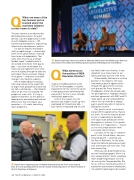
 Daniels moderated a discussion with U.S. Maritime Administrator Ann Phillips at the American Association of Port Authorities (AAPA) Legislative Summit in Washington, DC in mid-March.
  QWhat drew you to the position of MPA Executive Director?
I had an incredible position as the CEO of Port Everglades. I could’ve stayed there for the rest of my career. It was going to take something that was perfect for me to even consider leaving that opportunity.
A lot of the reason why the decision was made to come up here was based on the personal side. I have family in Maryland and my wife
has family that lives close by. It was important to us to be closer to our family and enjoy our time with them.
Professionally, Baltimore is a critical position in the industry. We have tremendous growth opportunities through the agreements we have with groups like Ports America Chesapeake. And on the private side, the development at Tradepoint Atlantic and their agreement with MSC and TiL really opens up a ton of possibilities where we can really be a change agent, specifically when it comes to distribution centers.
Our growth curve is extremely steep with the opportunities that are out there. To see the way the private sector is responding to demand with large-scale distribution center development, whether it’s in greater Baltimore or in Hagerstown — it puts us in a very unique position to be successful into the future.
Last year, of the top 11 container ports in the United States, only one showed growth — and that was
the Port of Baltimore. All the other large international gateways actually saw a decrease year over year. That says something.
While you can build infrastructure, you can’t build geography. We’re in a very unique location. Some would say that’s a bad thing because we’re all the way up the Chesapeake Bay. But for us, with our core business lines in automotive and container distribution, it’s a distinct advantage to be located
  Daniels was a frequent presence at Unified Command inside the Port’s cruise terminal.
Here, he is seen speaking with U.S. Sen. Ben Cardin. In the background is Col. Estee Pinchasin of the U.S. Army Corps of Engineers.
[18] The Port of Baltimore ■ ISSUE 2 / 2024


